STUDENT ACTIVISTS @ BLAKE
Reece Sanders and Will Bean take the road
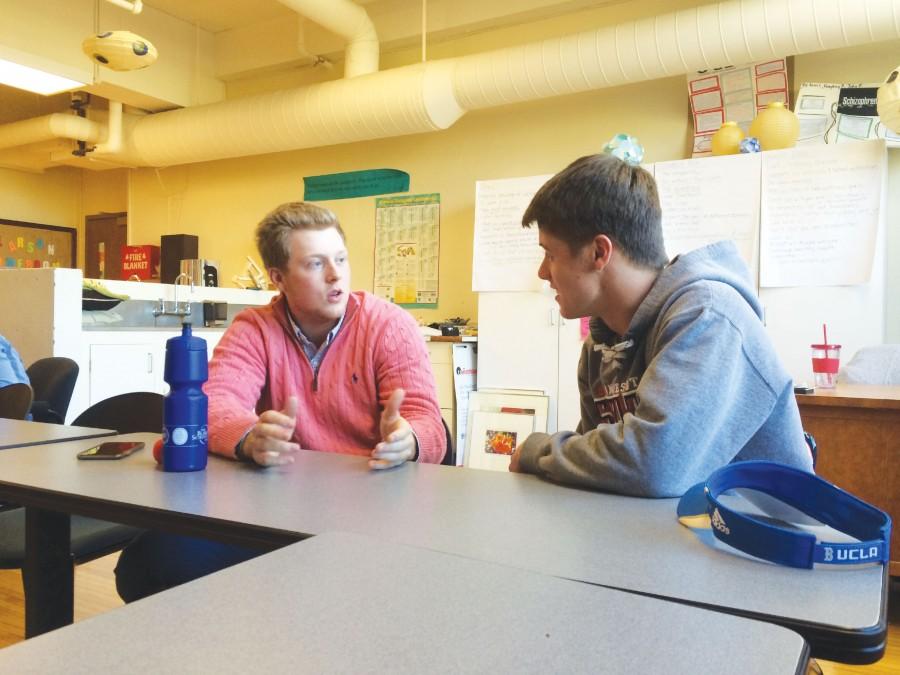
Reece Sanders ‘17 and Will Bean ‘17 discuss a plan of action.
For Reece Sanders ‘17, all it took was a moment. As he changed the radio station—something he’d done countless times before—he took his eyes off the road for a split second. That was all it took to cause what Sanders calls “a bad crash.” In the aftermath, he was left with a changed perspective. Shaken by his experience, he teamed up with classmate Will Bean ‘17 to attack the growing issue of distracted driving.
Bean says his connection to the issue comes from a deeply personal source. “I’ve lost friends to distracted driving,” he says. When the two boys were presented with the opportunity to address the issue in Dion Crushshon’s Global Theories, Local Realities class, Bean says they both “wanted to do something about it.” Sanders added that they wanted to “do [their] part and raise awareness.”
Indeed, the issue of distracted driving has affected more students at the school than just Sanders and Bean. One student, who asked to remain anonymous, says, “I got a ticket for texting and driving when I was lost and pulled out my phone to look for directions.” At the time, he says he wasn’t aware of “just how distracted [he]was.” Afterwards, he says he “had seen firsthand that [he] could be the cause of a serious accident someday if [he] continued falling prey to distractions in the car.” Stories like these were another source of motivation for Bean and Sanders as they began to look for ways to curb the problem.
Bean and Sanders teamed up with the Minnetonka Police Department to look into the causes and potential methods of prevention for distracted driving accidents. The issue couldn’t be more relevant: the National Highway and Transportation Administration recently released data that shows distracted driving fatalities increased by 22% between 2002 and 2011. Furthermore, the data shows that texting and driving causes roughly a quarter of all accidents each year.
Together with the Minnetonka P.D., Bean and Sanders devised a number of methods to address this issue head-on.
According to Bean, their first initiative was “putting up a sign at the intersection of Highway 7 and Highway 101 that explains the danger of texting at a red light.” Sanders added that this was one of the areas deemed “especially dangerous” by the police due to the high number of crashes at the intersection each year.
Next, the two presented to sophomore health classes and their grade on the dangers of distracted driving. With each action, their work has gained increased visibility and awareness, including features in Lakeshore Weekly and the Star Tribune.
Going forward, Sanders says they plan to “present at teacher and parent meetings.” They have also arranged for a speaker to visit the school and talk to students about her firsthand experience with distracted driving.
All in all, personal experiences have provided the motivation to get up and act for both of these students. Through their joint efforts to educate both students and Minnesota drivers as a whole, the roads look to be safer and more attentive for all.
Hailing from the leeward side of Oahu, Will Kaback was a first year editor as a Junior. As the previous Sports Editor, he brings with him a lifelong devotion...
Isabel has been writing for Spectrum since freshman year and this is her third year as an editor. She was formerly an Editor of Arts and Culture and...
![From top to bottom: 1. On protecting the Boundary Waters, Otis Environmental Author Amy Freeman said, “If you’ve been before, try and take someone new the next time you go. I think the more people that know about the place [they] understand it, love it, and want to protect it.” 2. Lower schoolers danced around the stage, eventually forming a mosh pit. The dancing intensified, leading to the band to ask kids to return to their families. 3. The Bennett Gallery features nature artwork from students of all grade levels, including Arthur Risdall ‘37 and Lilah Mairose ‘28. The curators wanted the gallery to feel like taking a walk outside. 4. Eighth graders in Woodshop created canoe paddles for the exhibit. The canoe was a reference to the Freemans’ book, “North American Odyssey, 12,000 Miles Across the
Continent by Kayak, Canoe, and Dogsled.” 5. Students listen during assembly as the Freemans share
their experiences in the JNA. 6. Alex Rozumalski ‘26 made artwork in a joint project between Block Printmaking and Marine Biology. The text by Rozumalski’s artwork said, “We have over-harvested, pollluted, and physically altered ecosystems, in some places irreparably. But it doesn’t have to remain that way.” 7. Lower School students created an eco-friendly felt art piece of the natural world. Most of the
wool was dyed naturally with onion skins, choke berries, indigo, and dahlia flowers. 8. Many families enjoyed the Okee Dokee Brothers concert. Overcash reminisced, “My dad has always been a fan of folk music, so the Okee Dokee Brothers reminds me of him. I think he got me into it.”](https://www.blakespectrum.org/wp-content/uploads/2026/05/Untitled-design-1-424x600.png)