Global experiences enrich summer break
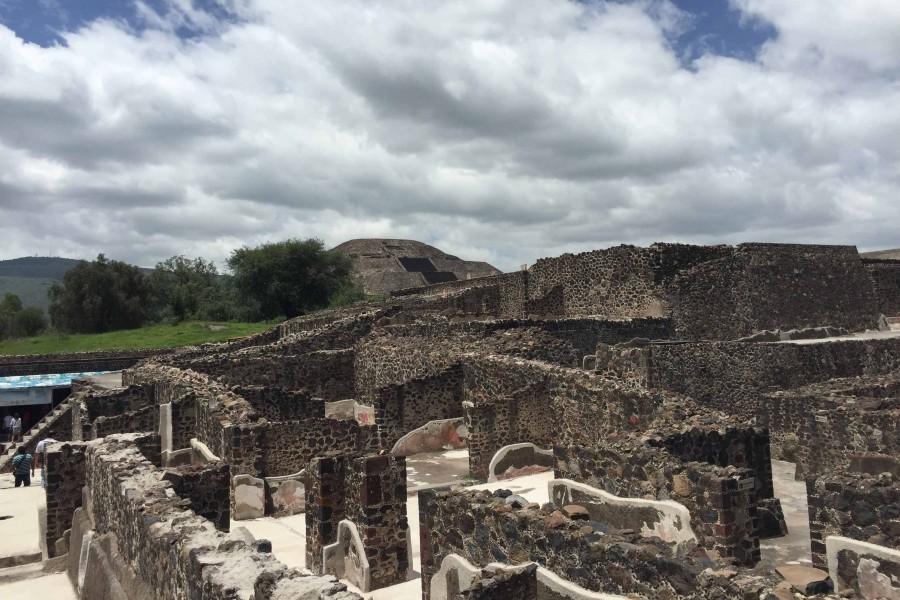
Tucked in a warm, two-story house in the residential part of Cuernavaca, Mexico, Sean Ericson ‘16 spent five weeks of his summer pursuing linguistic and cultural fluency.
In this five-person family’s home, Ericson experienced traditional food, lively discussion, and a “great atmosphere.” This homestay, along with a classroom experience, made the trip as impactful as it was. Ericson says himself that “the cultural integration was the most essential part of the experience, without which the academic component would be significantly weakened.”
The school’s mission for a global education is embodied in this trip. School programs are meant to develop “cultural competence, awareness of global issues, facility in other languages, and social conscience.”
While Ericson’s language skills improved from his daily classes, “the single best indicator of [his] progress in learning Spanish was [his] ability to carry on an everyday conversation.” These conversations were facilitated out in the city, in his homestay, and with locals, modeling a direct engagement with a new culture.
Further, these encounters showed Ericson what is was like to feel like a foreigner; whether it was looking different or sounding different, Ericson remarks that he found value in feeling what it was like “not [to be] a part of the standard landscape.”
Ericson’s experience, while academically enriching, found its deeper importance in the cultural engagement that came along with the more traditional learning. The culture of Cuernavaca shaped his stay, and just as it defined over a month of his summer, it has also left a deeper imprint on his cultural comprehension and integration skills.
Maxine has been a Spectrum Editor since the spring semester of her Freshman year. She was the Student Life Editor for her freshman/sophomore year on staff,...
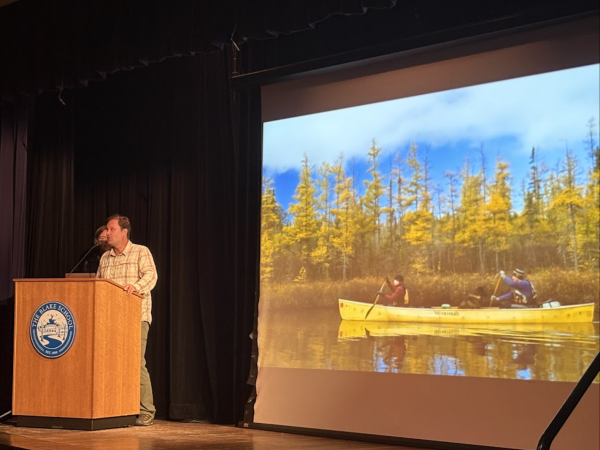
![From top to bottom: 1. On protecting the Boundary Waters, Otis Environmental Author Amy Freeman said, “If you’ve been before, try and take someone new the next time you go. I think the more people that know about the place [they] understand it, love it, and want to protect it.” 2. Lower schoolers danced around the stage, eventually forming a mosh pit. The dancing intensified, leading to the band to ask kids to return to their families. 3. The Bennett Gallery features nature artwork from students of all grade levels, including Arthur Risdall ‘37 and Lilah Mairose ‘28. The curators wanted the gallery to feel like taking a walk outside. 4. Eighth graders in Woodshop created canoe paddles for the exhibit. The canoe was a reference to the Freemans’ book, “North American Odyssey, 12,000 Miles Across the
Continent by Kayak, Canoe, and Dogsled.” 5. Students listen during assembly as the Freemans share
their experiences in the JNA. 6. Alex Rozumalski ‘26 made artwork in a joint project between Block Printmaking and Marine Biology. The text by Rozumalski’s artwork said, “We have over-harvested, pollluted, and physically altered ecosystems, in some places irreparably. But it doesn’t have to remain that way.” 7. Lower School students created an eco-friendly felt art piece of the natural world. Most of the
wool was dyed naturally with onion skins, choke berries, indigo, and dahlia flowers. 8. Many families enjoyed the Okee Dokee Brothers concert. Overcash reminisced, “My dad has always been a fan of folk music, so the Okee Dokee Brothers reminds me of him. I think he got me into it.”](https://www.blakespectrum.org/wp-content/uploads/2026/05/Untitled-design-1-424x600.png)