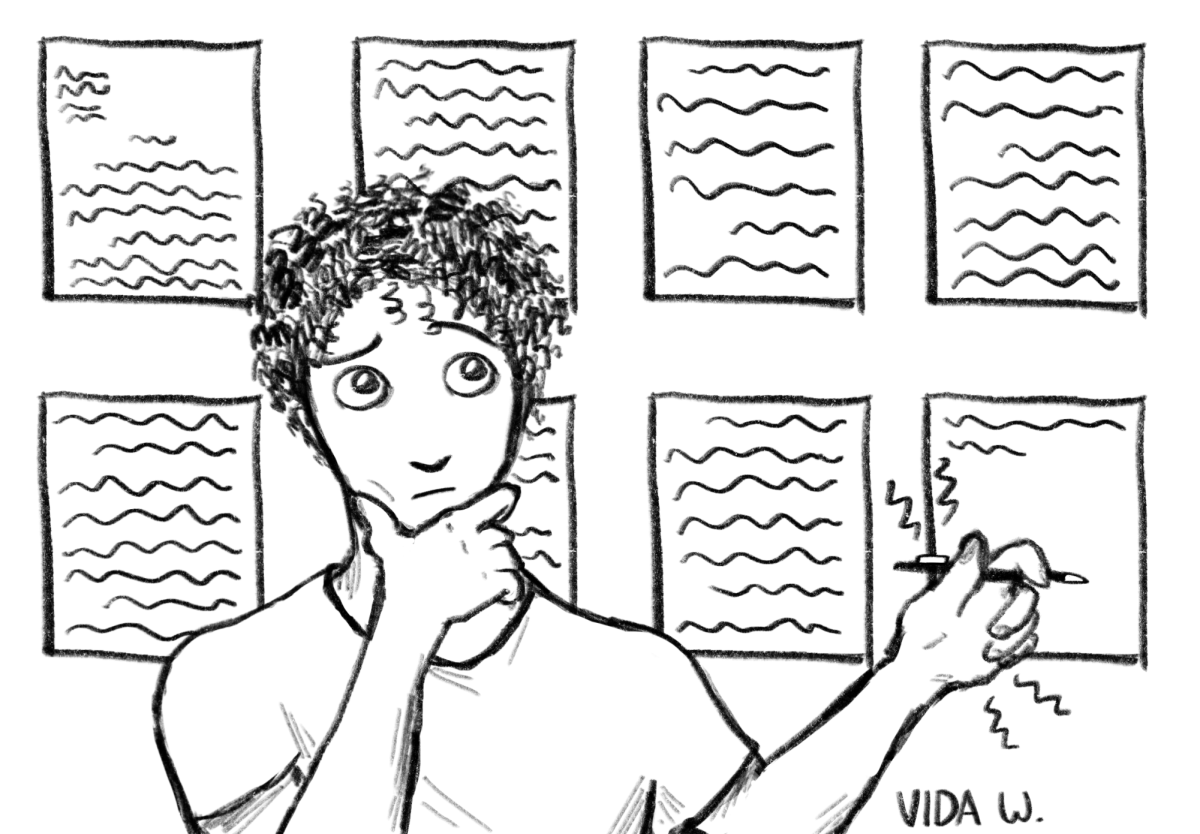
A hand raises, hesitates, then lowers. Silenced by an invisible weight, the potential to be ‘wrong’ or ‘offensive.’ Educational institutions across the country are burdened by a concerning rise in polarization in political discussion. Northrop is no exception. Promoting a space where all ideas are welcome is more crucial now than ever. Even as a place of learning, the school has formed an echo chamber where self-censorship feels safer than honest discussion.
School is “where you learn most of the stuff in your life, and I think it’s important for people to learn about politics unbiased,” stated Elizabeth MacNeill ’27. However, “I think sometimes students don’t share their opinions.” With the largely liberal community of the school, sometimes just agreeing or acknowledging certain views that are generally considered more conservative is often met with harsh criticism, especially from students. The same is true in more right-leaning schools with left-leaning perspectives. However, the issue persists when discussing controversial topics, such as affirmative action and certain political figures.
Yet, our education isn’t necessarily to blame. While teachers’ general political opinions inadvertently make their way into lessons and discussions, there’s another layer of self-censorship on topics. Student culture perpetuates this strange dynamic.
Our culture of delegitimizing opinions that we’ve predetermined as wrong is a very concerning trend, especially in the educational sphere. One example of this is the recent rise in political violence, in which there has been an unsettling number of students and the general public celebrating when perpetrated against the opposing party. Furthermore, I remember when discussing colonization in 9th grade, feeling uncomfortable asking the question, “Why do we focus so much on colonization by Europeans in discussions when it was such a global issue?” I kept replaying the question in my head, wondering if it would sound insensitive. I wasn’t defending colonialism, but what if it sounded that way? That moment made me realize that self-censorship wasn’t always imposed, but self-inflicted. These experiences show how easily open-minded conversations give way to fear and judgment.
The real issue here is how this student culture of believing certain beliefs are flat-out wrong, especially when this culture has become normalized. On an academic level, the problem with this is how we’ve started to lean towards groupthink. Where everyone generally has the same ideas, and when ideas don’t fit the mold of what’s acceptable, they’re self-regulated out of conversations. This is harmful because perspective is essential to critical thinking and a genuine understanding.
When voices fall silent, and self-censorship becomes normalized, we foster a culture of one-sided ideas, where we don’t always build the accepting and open-minded community we claim to. It’s only when we change our framing around politics and global issues, from a good or bad binary to a spectrum, that we can truly maximize and engage in our learning.

![Graphic Artist Wolstencroft shared about her process making this graphic: “I used an app called Procreate. The first thing I did was manually remove the background from all of the [movie] posters [featured in this article]. Then I decided which color scheme I liked best...and I used gradient maps to get the colors to be uniform. I [also] added some extra shading and a background, and it was done.”](https://www.blakespectrum.org/wp-content/uploads/2026/05/0-1200x834.png)