Latino Immigrants do not travel to the border for no reason.
They are pushed there by U.S. policies and operations that create crises that did not begin with
them, yet still land on them the hardest. When Americans ask how to stop migrants, they skip the more uncomfortable question first: What made their home unlivable in the first place?
Contrary to the government’s blind claims, for many in Central and South America, the answer is not as linear as we think; it’s not just a single gang or a single corrupt administration.
In fact, we must question and examine how people like Pinochet and Carlos Armas came to power. Decades of the United States mingling in their politics and economic extraction of their natural resources are behind the wave of immigration we see today.
Countries like Nicaragua, Honduras, and Venezuela did not simply fail on their own because of their “corrupt systems.” Democratically elected governments were undermined and overthrown by American force and support when the foreign government’s policies threatened American companies and America’s Cold War interests. Military regimes and violent dictators hand-picked by the United States are armed, trained, and financed in the name of “stability”. All of this is not a story of the past; these decisions that the government continues to make echo back with organized crime, poverty, and broken economies that people flee today to come to our homeland.
To understand why so many families risk everything to reach the United States, we have to trace specific cases and stories rather than vague narratives of seeking opportunity. We must ask the whys of issues because our own government cannot and will not.
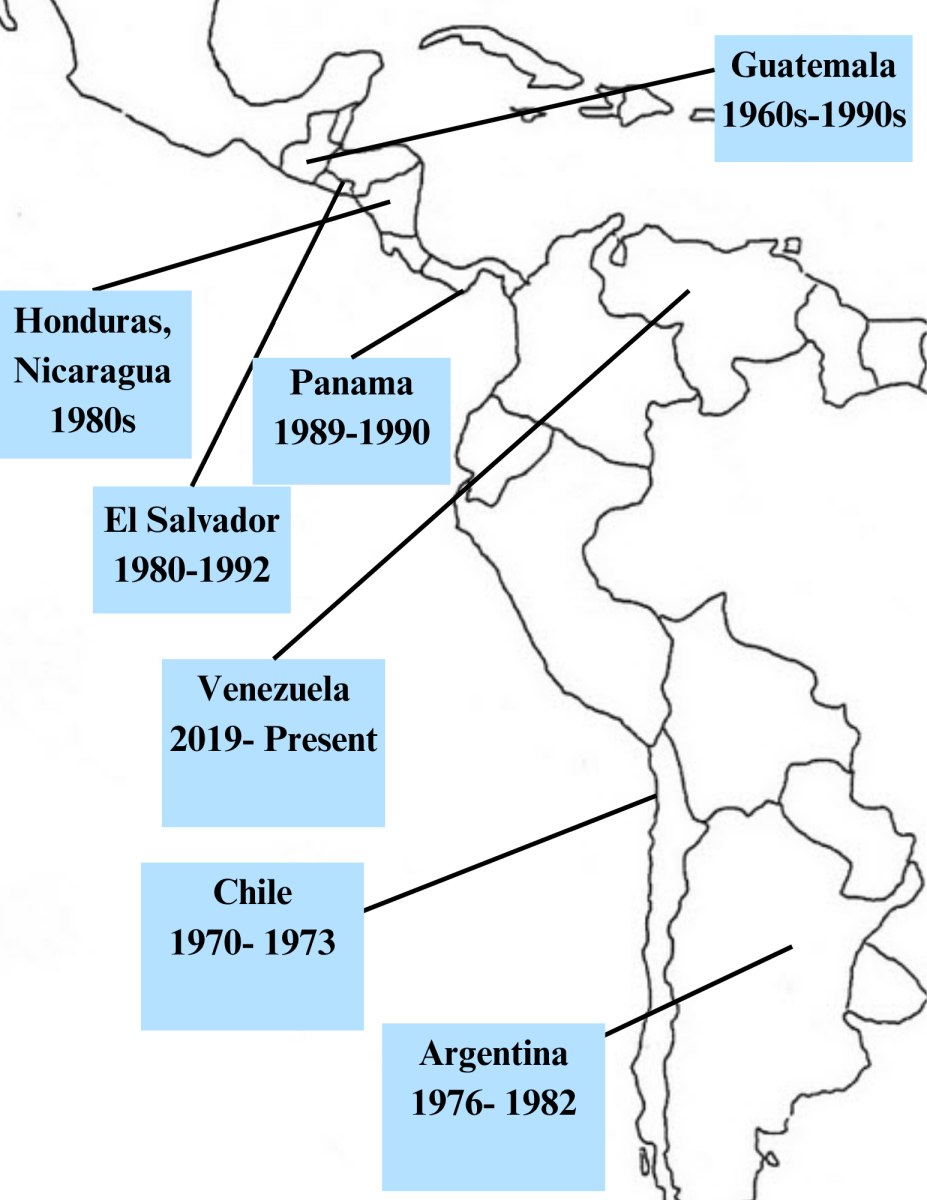
When Guatemala’s 25th President, Jacobo Árbenz, tried to redistribute unused land held by a large U.S. Fruit Company, the CIA performed a coup against the government and completely derailed reforms that would make owning land more just and improve the quality of life of the average Guatemalan.
In Chile, a democratically elected government under Salvador Allende was overthrown again by the U.S. government and replaced with a violent military dictatorship led by Augusto Pinochet that imprisoned and tortured thousands of innocent Chileans.
In Central America, the U.S. armed and funded Anti-Communist combatants in civil wars in El Salvador, Guatemala, and the Contras in Nicaragua, extending and deepening conflicts whose traumas are still carried by the people today.
“I don’t see why we need to stand by and watch a country go communist due to the
irresponsibility of its people. The issues are much too important for the Chilean voters to be left
to decide for themselves.”
-Henry Kissinger, Former U.S. Secretary of State
Apart from the moral implications of U.S.-backed regime change, their actions have caused major financial damage as income lowers, inequality grows, and key industries are hurt. Frequently, the actions of the U.S. government were the difference between a table with food and a home with nothing, between a town with a functioning school and a town with only functioning organized crime. Parents do not walk, run,and swim thousands of miles with toddlers just chasing opportunities that were stripped from
them by the United States; they flee because staying means hunger, poverty, and death.
Alongside these political interventions come economic ones as our own government treats foreign rare earths and natural resources as open fields for its own profit. Latin American governments that try to redistribute land, create stable domestic industries, and reclaim control over their minerals, oil, and infrastructure are deemed dangerous the moment they start benefiting from it. The U.S. government not only spreads false rhetoric about these places but also punishes their governments with political pressure and sanctions, laying the ground for future control as they just did in Venezuela.
Taking this into consideration, the U.S. border is not just a geographical line. It’s a wall that hides morals and cause and effect. A strictly closed border leads citizens to assume they owe nothing to the people displaced by their own government’s foreign policy. Nationalist Americans blindly say that America is the greatest country on earth, not even considering how many people had to suffer and die for it to be that way.
Introducing a more open border policy does not undermine or deny that migration policies should be enforced; it is to insist that any serious conversation about this must recognize the historical link between what our government has done to these people and their homelands, and why their citizens are moving. A just border policy that gives more asylum access and treats people from these regions as neighbors affected by our own choices is not an act of generosity. It is a form of restitution and empathy for all.
Latino Immigrants are not asking for a favor when they come to the United States. They are moving through a country that has already moved through them, through their governments, their economies, and their lands. A country that has stolen so much from them and closed the door behind them.
If doors were locked against them by decisions made in Washington, then slightly opening the door at the southern border is not a radical action. It is the start of justice that the United States stripped from them.
![Graphic Artist Wolstencroft shared about her process making this graphic: “I used an app called Procreate. The first thing I did was manually remove the background from all of the [movie] posters [featured in this article]. Then I decided which color scheme I liked best...and I used gradient maps to get the colors to be uniform. I [also] added some extra shading and a background, and it was done.”](https://www.blakespectrum.org/wp-content/uploads/2026/05/0-1200x834.png)