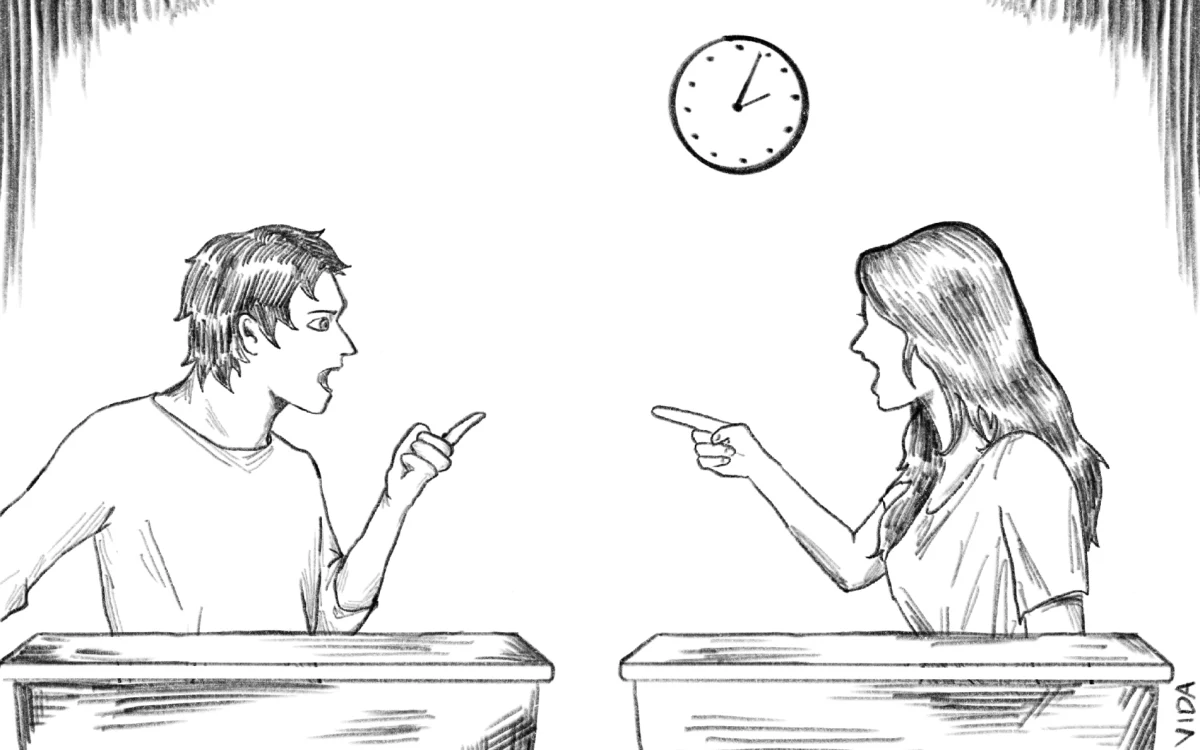
You don’t need me to tell you that we are polarized. That has been slammed into every American citizen from constant barrages of articles (including my own), books, and movies. But the media misses something important: polarization isn’t abstract. It is right in front of your face.
You hear it in the sighs and disengagement from classmates when a student makes a heavily political statement. You hear it in the hallways when students gossip about which teacher will dock them points for not being liberal enough. You see it: only 4% of respondents in the April Poll consume any traditionally conservative news sources.
Political polarization isn’t a distant boogeyman. It’s not hiding under your bed. You stare it in the eyes every single day. To deal with it, we have to see that it is not a supervillain. It is the air between you and your parents at the dinner table that seems to go stale when politics comes up.
I would argue that the air is stale because these are people that we care about. As humans, we inherently try to avoid disputes. But just because we pretend that the air isn’t stale doesn’t make the disagreement go away. It festers.
So what if we try something novel? I suggest that we embrace it. Disagreement across political boundaries should be hard. It is uncomfortable. It will make you frustrated. It will make you angry. That’s a sign that it is working.
Think of this discomfort and political disagreement as the longest field trip. There is no permission form and no school bus to take you away. So let’s buckle up and learn from it.
Proponents of experiential learning have long claimed discomfort drives growth. But this isn’t just rhetoric; there’s research. Psychologists have found evidence that the same applies to political disagreement. A 2022 study by Cornell professor Kaitlin Woolley showed that people who embraced discomfort were more motivated in political discussions and were more successful in certain tasks.
So, how do we go about engaging in this field trip the right way? I have three thoughts.
First, listening. While listening has been taught since infancy, we sometimes forget to do it. As Harvard professor Julia Minson found in a 2019 study, people minimize the intelligence, morality, and objectivity of those they disagree with in political discussions. The other person in the room is not dumb, nor are they immoral. They are human. Same as you. So take their point in. Listen, looking to understand their point, not to build an opposition.
Second, converse without trying to convince. Life-changing conversations are not common. It is good that you don’t need to agree with everyone in the room. When you leave the room, the other person probably will still disagree with you. That doesn’t mean they’re wrong. If conversation only works when someone agrees with you, that’s not conversation. UCLA Assistant Professor Hanne Collins found in a 2022 study that “people consistently underestimated how willing disagreeing counterparts were to learn about opposing views.” That means that there are genuine opportunities to learn from one another. People want to understand your point.
In addition to people wanting to understand, it’s also necessary. We actually have to see one another every single day. We don’t have social media culture war accounts with millions of viewers. So, we don’t get to choose. In the classroom, in the halls, we will interact. So instead of shutting down, refuting, and stagnating ourselves, why don’t we learn from one another?
Because that’s what it is all about. The best and worst thing about this world is that we are stuck here, together. There is a diverse, expansive, and conflicting understanding of what it means to be here. And we won’t agree. And maybe the air will still be stale. But at least we will be talking– that’s where the learning starts.




![Graphic Artist Wolstencroft shared about her process making this graphic: “I used an app called Procreate. The first thing I did was manually remove the background from all of the [movie] posters [featured in this article]. Then I decided which color scheme I liked best...and I used gradient maps to get the colors to be uniform. I [also] added some extra shading and a background, and it was done.”](https://www.blakespectrum.org/wp-content/uploads/2026/05/0-1200x834.png)