Adeola Adesanya
Lifelong learner, businessman, teacher, immigrant… Ade is someone to know
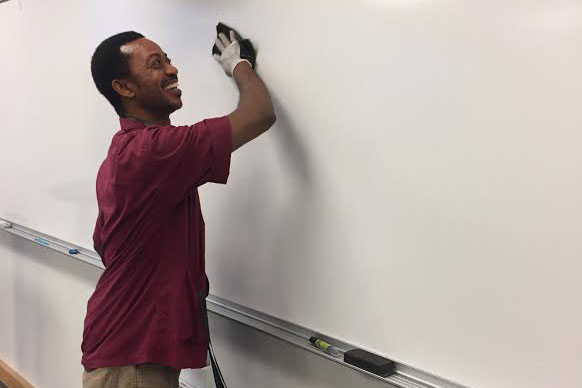
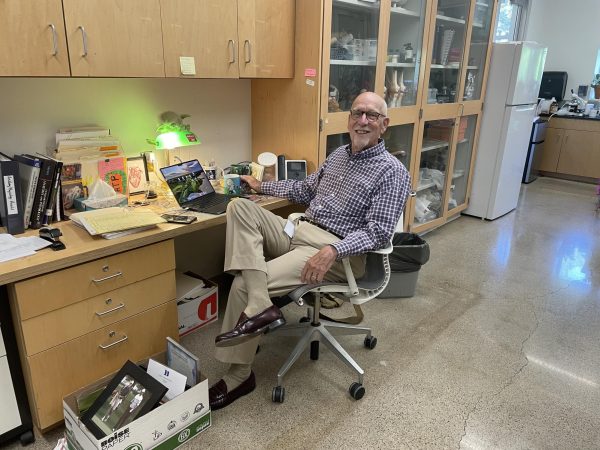
Walking into the darkly lit classroom, he picks up an eraser to begin his cleaning routine. Before taking the cloth to the board, though, he reads. He reads what the teacher and students have left on the board as evidence to the learning that occurred in the hours before. Adeola Adesanya is not absentmindedly cleaning the mostly-empty school where he works, but engaging in the learning that has been left for him to take in.
Adesanya says, “Every time I enter a classroom I still look at the board and gain some things from what’s written.”
Adesanya reads the boards every night because he loves to learn, and that passion has been instilled in him since he was younger. Growing up in Lagos, Nigeria, both of his parents were teachers. He says, “We had a lot of books at home. We had virtually all books.”
He grew up reading every day, book after book, and began to take an interest in geography. He then earned his bachelor’s degree in geography and teaching in Nigeria before becoming a high school teacher. “We call it secondary school in Nigeria,” Adesanya says.
He was a geography teacher for three and a half years before going back to school to earn his Master’s degree in the subject.
When asked why he is so interested in studying geography, Adesanya says, “It’s an opportunity to know what’s happening around you and all over the world.” He continues, “When you look at it, what is geography? Virtually everything is geography. The whole world is geography.”
Adesanya sees studying the physical features of the earth as a way to understand the vastness of the planet where we live and hopefully gain understanding of places different from our home country.
When Adesanya moved to the United States three years ago, a school environment was a comfortable home for him. He has been working at our school for almost a year now and has tremendously enjoyed being back “in school.”
Adesanya says, “Even when I walk in here, and it’s not a teaching job, I’m learning like [I do at] school.”
When he’s not taking in knowledge at the school, he’s learning at home. He studies on his own time when he has days off and he loves to watch the news. “I don’t watch movies, I watch news,” he says.
He watches Nigerian and American news every morning and says that if he could have one day off to do anything he wanted, he would watch the news and go to the park.
Adesanya rarely has time to stop working, though, as he is involved in numerous business pursuits. Before he left Nigeria he started his own company where he sends goods from Nigeria to other places in the world. Now that he’s here, he serves as a passageway between Nigeria–and other parts of Africa like Ghana and Liberia–and America.
He says, “People here want to send some things, some goods, to their family in Africa, want to buy something from [Nigeria] and bring it up.” He is running his business from America and is hopeful that he can make enough money to bring his family here too.
“With God, and hard work, I can actually do it. I’m so optimistic about it,” Adesanya says.
With everything that he does, Adesanya loves to meet and talk to new people every day. He says, “I don’t have a lot of time to see people, but when I meet someone I ask their name.” He continues, “I like to know people by their names. I want to call the person by their name the next time I see them.”
There is a comparison to be made between Adesanya’s work in geography–studying the names of places and landmarks–and his pursuit to know everyone by their name. Next time you see Adesanya reading the boards in your history classroom, say hello and tell him your name. There is more to be found underneath his red cleaning company uniform.
Hello! It's me, your trusty Editor-in-Chief. I have been an editor since the spring of my Sophomore year, and I haven't looked back since. I have edited...
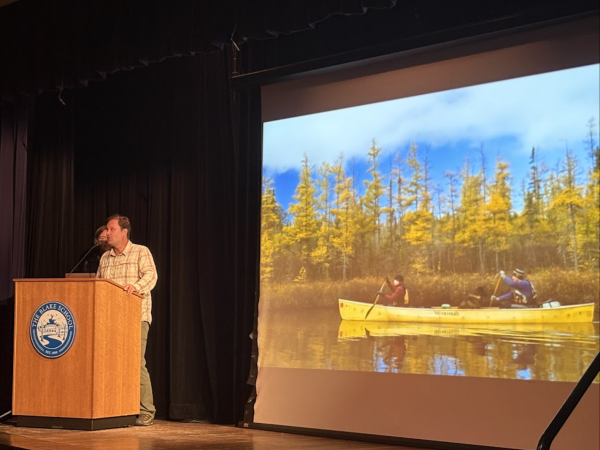
![From top to bottom: 1. On protecting the Boundary Waters, Otis Environmental Author Amy Freeman said, “If you’ve been before, try and take someone new the next time you go. I think the more people that know about the place [they] understand it, love it, and want to protect it.” 2. Lower schoolers danced around the stage, eventually forming a mosh pit. The dancing intensified, leading to the band to ask kids to return to their families. 3. The Bennett Gallery features nature artwork from students of all grade levels, including Arthur Risdall ‘37 and Lilah Mairose ‘28. The curators wanted the gallery to feel like taking a walk outside. 4. Eighth graders in Woodshop created canoe paddles for the exhibit. The canoe was a reference to the Freemans’ book, “North American Odyssey, 12,000 Miles Across the
Continent by Kayak, Canoe, and Dogsled.” 5. Students listen during assembly as the Freemans share
their experiences in the JNA. 6. Alex Rozumalski ‘26 made artwork in a joint project between Block Printmaking and Marine Biology. The text by Rozumalski’s artwork said, “We have over-harvested, pollluted, and physically altered ecosystems, in some places irreparably. But it doesn’t have to remain that way.” 7. Lower School students created an eco-friendly felt art piece of the natural world. Most of the
wool was dyed naturally with onion skins, choke berries, indigo, and dahlia flowers. 8. Many families enjoyed the Okee Dokee Brothers concert. Overcash reminisced, “My dad has always been a fan of folk music, so the Okee Dokee Brothers reminds me of him. I think he got me into it.”](https://www.blakespectrum.org/wp-content/uploads/2026/05/Untitled-design-1-424x600.png)