

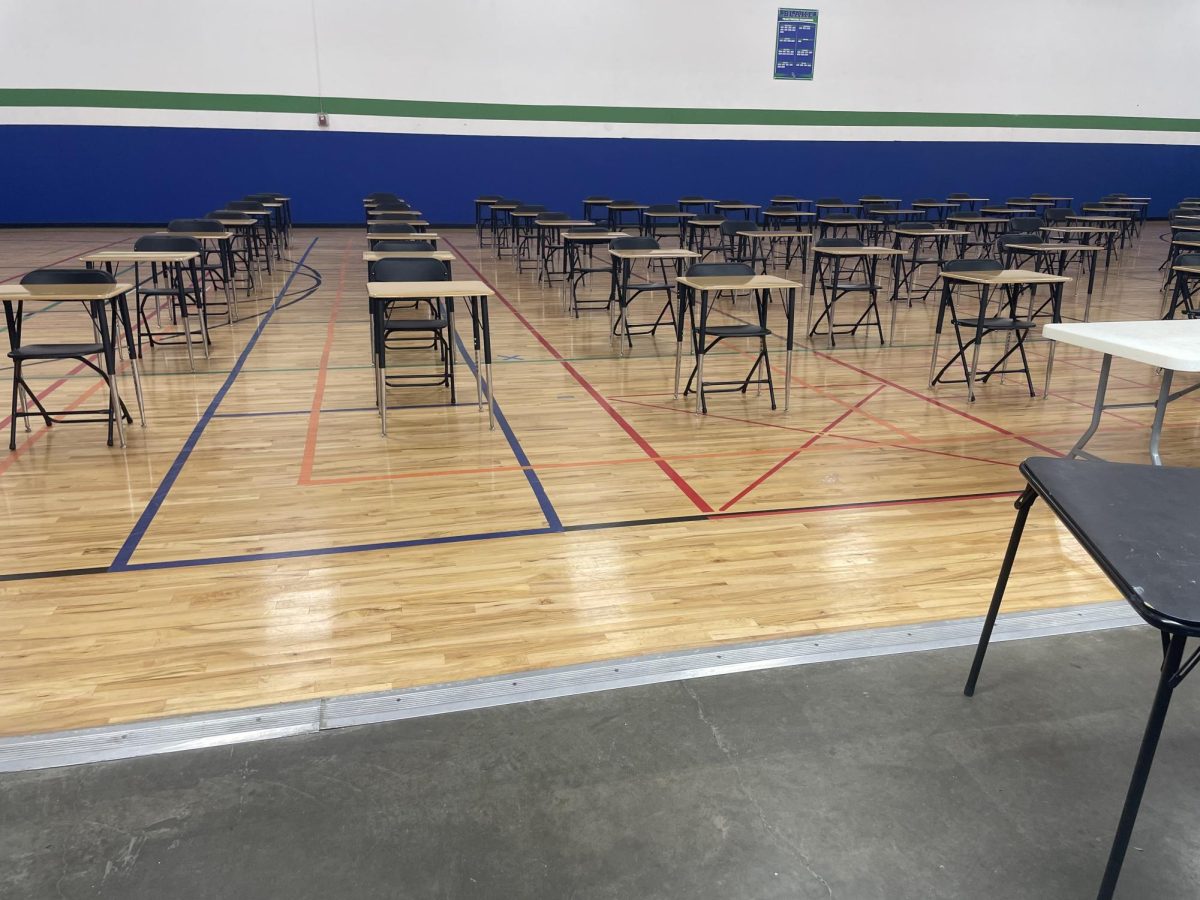
On Thursday, Feb 12, SIAC hosted a “No-Phones Day” as a part of the Upper School Olympics. Students competed from every grade level, turning in phones in the Junior Lounge at 8:15 a.m. and receiving phones after 2:30 p.m. The Spectrum Editorial Board took this event to consider our current phone protocol and its ramifications in three aspects.
First, policies need student support to be functional. Students are endlessly innovative in finding ways to access the internet. In an evolving technology landscape, administrators and teachers cannot outpace students in understanding the internet’s landscape. If students want to play games, they will find a way to do so. In a more educational sense, as we learn agency and decision-making, complete oversight from teachers and administrators is not beneficial for students; excessive oversight hinders our growth.
Secondly, we generally support the current phone policy outside of classes. For some, phones serve as a way to detach from daily stress. This takes place through mobile games, short-form videos, and communication with friends. The point is not to do anything of any purpose, but instead rest. Allowing students to use their phones provides respite in an otherwise stressful day.
Although enforcement of the phone hotel policy has been rather lax, we still believe it provides an opportunity for students to learn to learn without their phones. Inherently, phones in classrooms are distracting for students. Therefore, the impetus of phone hotels and the commitment to learning must fall on students.
However, we also acknowledge the negative impacts of phones on students through social-emotional and intellectual levels. As Bernt Bratsberg found in his study, “The Flynn effect and its reversal are both environmentally caused,” phones have led to a drop in Intelligence Quotient (IQ) in recent years. In the 20th century, IQ increased incrementally, but newer generations are experiencing a drop. Due to IQ’s controversial history in discriminating against marginalized groups, we do not consider IQ in isolation. We are also concerned about the general drop in Emotional Quotient (EQ) observed in the school’s hallways.
Finally, we condemn the further use of statistics, especially negative statistics, to persuade students to forgo phone usage. The messaging has become blunt. Statistics are no longer a warning, but a subject to laugh over. When students are forewarned of an IQ drop or shamed for lack of attention span, it is taken lightly; an unfortunate joke in which we all share experience. Fear-mongering does nothing but build resistance to the message and tolerance of our current phone usage. To truly find a way out of the current screen problem, the movement must be initiated by the students.




![Graphic Artist Wolstencroft shared about her process making this graphic: “I used an app called Procreate. The first thing I did was manually remove the background from all of the [movie] posters [featured in this article]. Then I decided which color scheme I liked best...and I used gradient maps to get the colors to be uniform. I [also] added some extra shading and a background, and it was done.”](https://www.blakespectrum.org/wp-content/uploads/2026/05/0-1200x834.png)

![Wolstencroft described, “The corporate investor is letting himself
be completely drained by the AI.” She added that “It is actively
harming him [like] everyone who uses generative AI, and soon there
won’t be anything else to take.”](https://www.blakespectrum.org/wp-content/uploads/2026/01/3795AFBC-FE30-48BF-92E9-C8737A370518-1200x938.png)

